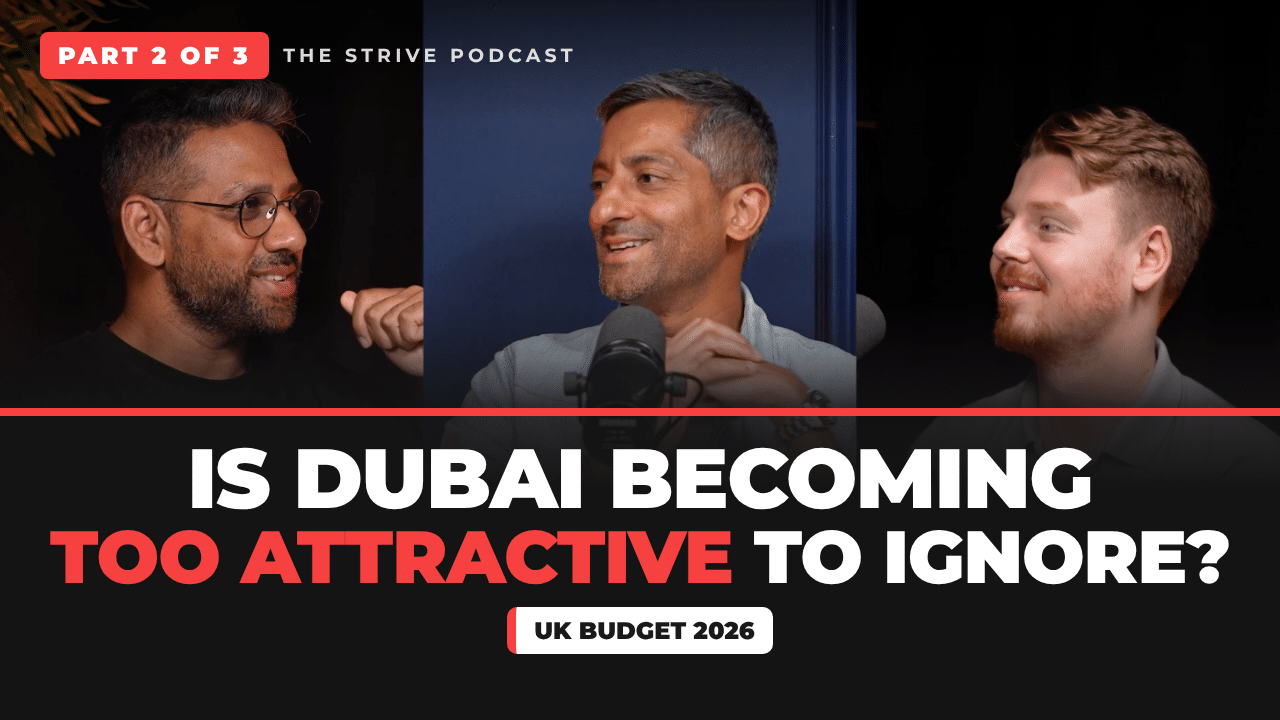
Now that the Autumn Budget has officially been delivered by the new chancellor, the intense pre-budget speculation and uncertainty have finally cleared. With the fiscal event behind us, business owners and high earners no longer have to guess about potential shocks and the reality on the ground has made Dubai more attractive than ever.
In Part 2 of The Strive Podcast, host Pali Banwait, Chief Revenue Officer Dipesh Virji, and Chartered Tax Advisor Henry Smith-Langridge examine the growing economic pressures in the UK and why more professionals are looking toward the UAE for relief.
Watch the Full Series
Want to explore the complete multi-part conversation on cross-border structuring, tax strategy, and asset protection? Watch the full series on YouTube:
1. The Squeeze on UK Landlords and Businesses
Year after year, tax policies continue to tighten around property owners and small businesses. Landlords in the UK have faced an additional two-percentage-point increase in income tax rates across all brackets, compounding the ongoing operational squeeze.
While policymakers often frame these measures as targeting the wealthy, the reality on the ground is stark: increased costs on landlords and businesses inevitably result in higher rents for tenants and fewer entry-level opportunities for young workers trying to break into the market.
2. The Laffer Curve and the Productivity Problem
When tax rates climb too high, they cross the tipping point of the Laffer Curve—where the burden begins to stifle effort, discourage growth, and drive talent away.
-
The 60% Tax Trap: Earners crossing the £100,000 threshold face a tapered loss of their personal allowance, resulting in an effective tax rate of around 60% or higher.
-
Disincentivizing Work: High marginal tax rates and complex benefit structures discourage workers from taking on extra hours, bonuses, or promotions, directly feeding into the UK’s ongoing productivity stagnation.
3. The Rising Tax Burden on Dividends
Recent adjustments to dividend allowances and tax rates mean that successful entrepreneurs taking distributions from their UK companies face heavier personal tax bills.
However, the irony of these policies is that they primarily penalize individuals who remain tax-resident in the UK. Business owners who establish international structures or relocate to jurisdictions like the UAE can bypass these personal tax traps while retaining full control over their enterprise.
4. Why Dubai is the Ultimate Growth Hub
While the UAE is not the right fit for everyone, it provides a stable, predictable environment designed to foster business growth:
-
100% Remote Setup & Seamless Banking: Founders can establish a remote company structure and corporate bank account (via partners like Emirates NBD) without needing to travel for medicals or biometrics.
-
Fixed Cost Structures: Unlike the UK’s scaling employment costs and national insurance contributions, hiring and rewarding talent in the UAE offers a transparent, predictable framework.
-
Global Cash-Flow Efficiency: By utilizing global group structures, businesses can optimize their corporate tax liabilities—allowing them to reinvest surplus cash back into expansion rather than losing it to high domestic tax burdens.
Watch the Full Episode
Want to learn more about international tax planning, the “golden triangle” method, and how to protect your business growth? Watch the full discussion on YouTube: UK Budget 2026: Is Dubai Becoming Too Attractive to Ignore? | Part 2 of 3
What happens when working harder, earning more and growing your business starts to feel less rewarding? And at what point does Dubai become too attractive to ignore?
Book a one-to-one strategy call with Strive today