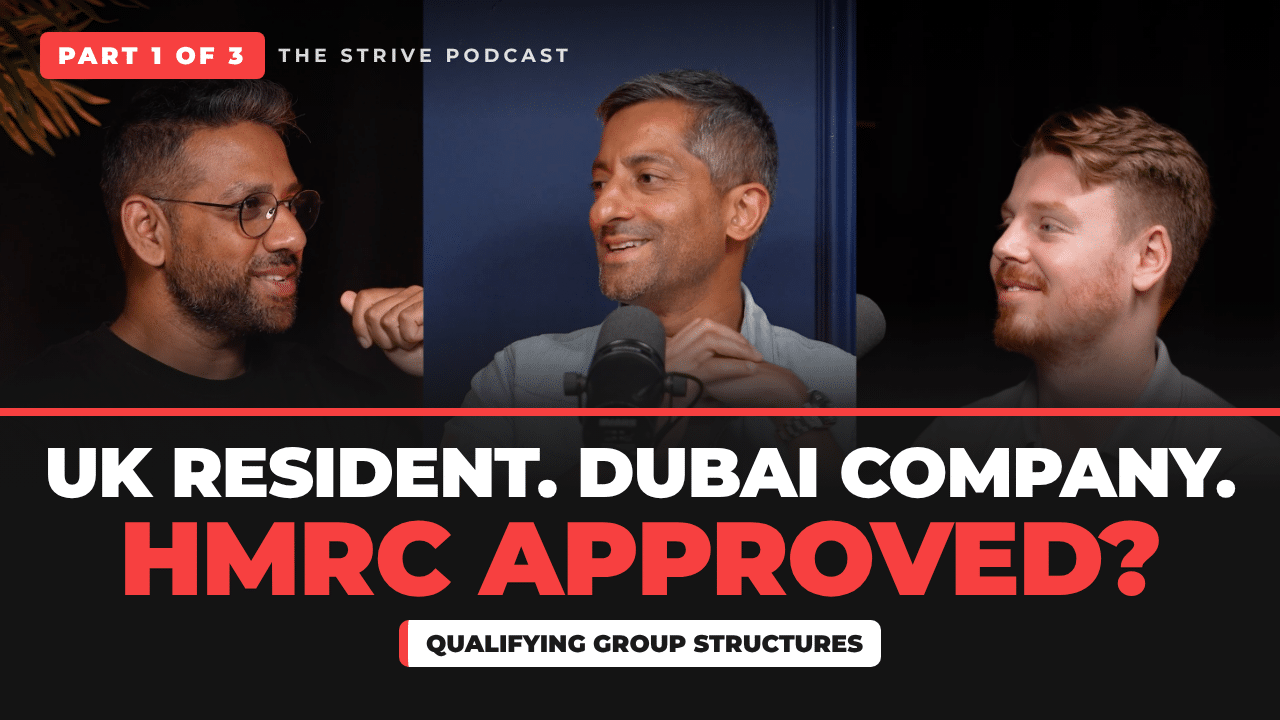
Setting up a business in Dubai while staying based in the UK has become one of the most popular strategies for modern entrepreneurs. But many business owners wonder: can you actually run a tax-efficient Dubai company structure without running afoul of HMRC?
In Part 1 of The Strive Podcast, host Pali Banwait is joined by Strive Chief Revenue Officer Dipesh Virji and Chartered Tax Advisor Henry Smith-Langridge to break down how qualifying group structures work, the reality of substance requirements, and how to stay fully compliant with HMRC.
Watch the Full Series
Want to explore the complete multi-part conversation on cross-border structuring, tax strategy, and asset protection? Watch the full series on YouTube:
-
Part 1: UK Resident. Dubai Company. HMRC Approved? – Qualifying Group Structures!
-
Part 2: UK Budget 2026: Is Dubai Becoming Too Attractive to Ignore?
-
Part 3: Can Dubai Foundations Cut Inheritance Tax, Fund School Fees & More?
1. The Power of a Qualifying Group Structure
For business owners feeling squeezed by high domestic taxes, setting up overseas can feel like the only way forward. However, simple offshore setups often fail because they lack the proper corporate layers to appease tax authorities.
A Qualifying Group Structure typically involves three key entities:
-
An existing home company (such as a UK limited company).
-
A holding company.
-
An operational entity based in the UAE.
By separating your holding activities from your operational ones, you can strategically shift certain operations to the UAE. The UAE entity can then invoice the UK business, creating a legitimate business expense on the UK side while moving profits to a favorable tax environment.
2. Why “Substance” Matters More Than Ever
Anyone can set up an online company anywhere in the world, but tax authorities like HMRC know this. If you try to shift profits offshore without real economic substance, you risk severe penalties.
To prove genuine substance and maintain an arms-length commercial relationship between your companies, you need:
-
Formal contracts detailing all cross-border transactions.
-
Strategic decision-making taking place in the UAE, including regular board meetings.
-
Geotagged documentation to prove that management control happens where your company is registered.
3. Can You Really Get HMRC Advance Clearance?
One of the biggest misconceptions is that communicating with tax authorities automatically triggers an investigation. In reality, getting HMRC statutory clearance for corporate reorganizations provides valuable peace of mind.
While clearance is not legally required to set up a group structure, submitting your plans in advance allows HMRC to review the arrangement. When structured correctly with the help of a qualified tax advisor, HMRC can provide written assurance that your setup complies with the law.
4. UAE Corporate Tax & Small Business Relief
A common myth is that navigating international tax requires blindly chasing a zero-percent rate without proper accounting. In the UAE, the tax framework offers significant relief for growing businesses:
-
Small Business Relief: Companies with a total revenue of less than 3 million AED (approx. £600k) per year can apply for 0% corporation tax.
-
Standard Corporate Tax: For revenues exceeding the threshold, a standard 9% corporate tax applies to net profits, alongside a generous tax-free threshold on the first 375,000 AED.
Watch the Full Episode
Want to dive deeper into corporate restructuring, transfer pricing, and profit extraction? Watch the full discussion on YouTube: UK Resident. Dubai Company. HMRC Approved? – Qualifying Group Structures! | Part 1 of 3.
What if you could stay in the UK, benefit from a tax-efficient Dubai company structure, and even get advance clearance from HMRC for a qualifying corporate reorganisation?
Sounds too good to be true? You might be surprised by what’s actually possible.
Book a one-to-one strategy call with Strive today