Setting up a company in Dubai can be one of the best decisions a UK founder makes. But only if it is set up properly.
On the Strive podcast The 2026 UK–UAE Tax Playbook, our Partner and Chief Revenue Officer Dipesh Virji shared a striking view. In his words, “probably north of 90%” of the businesses set up in the UAE by people from overseas, like the UK or other high-tax jurisdictions, “have been set up incorrectly.”
That figure is his estimate from the founders our team speaks to, not an official statistic. But the pattern behind it is real, and it can leave UK business owners exposed to problems with HMRC years after the setup is done. This guide explains why it happens, the most common mistakes, and what a correct setup looks like.
Why so many UAE setups go wrong
Most incorrect setups start with the same sales line: “Set up a company in the UAE, 0% tax.” The setup is sold as a commodity rather than a solution.
The problem is what that line leaves out. A UAE licence on its own does not change where you live, where your business is managed, or how money flows back to you in the UK. As Dipesh put it, often “there’s no conversation being had with the client” about their UK position at all.
The founders who set up this way are usually doing nothing dishonest. They want to reduce their tax liabilities legally, and they trust that the provider has thought it through. Often, no one has.
The four most common setup mistakes
Dipesh named four areas where setups most often go wrong.
- Not treating companies as separate entities. Your UK and UAE companies are separate legal entities and must be run that way. Blurring the line between them can create real problems with HMRC.
- Ignoring transfer pricing. When related companies trade with each other, HMRC expects those deals to be on arm’s length terms, priced as they would be between unrelated businesses. Many setups never consider this.
- No mechanism to move money between the UK and UAE. Moving funds needs the right structure and documentation in place before the money moves, not after.
- No plan for bringing funds back. Getting money into a UAE company is easy. Bringing it back to the UK efficiently is often where the problems start.
What’s at risk
The main risk is being “heavily exposed to problems down the line” with your home tax authority. For UK founders, that means HMRC.
If HMRC decides the UAE company is really managed from the UK, or that profits were shifted without proper arm’s length terms, it can look to tax those profits in the UK. HMRC can usually look back several years, so a problem built in at setup can surface long after.
The outcome depends on your circumstances. That is exactly why the structure should be reviewed against your UK position before you rely on it.
What a correct setup looks like
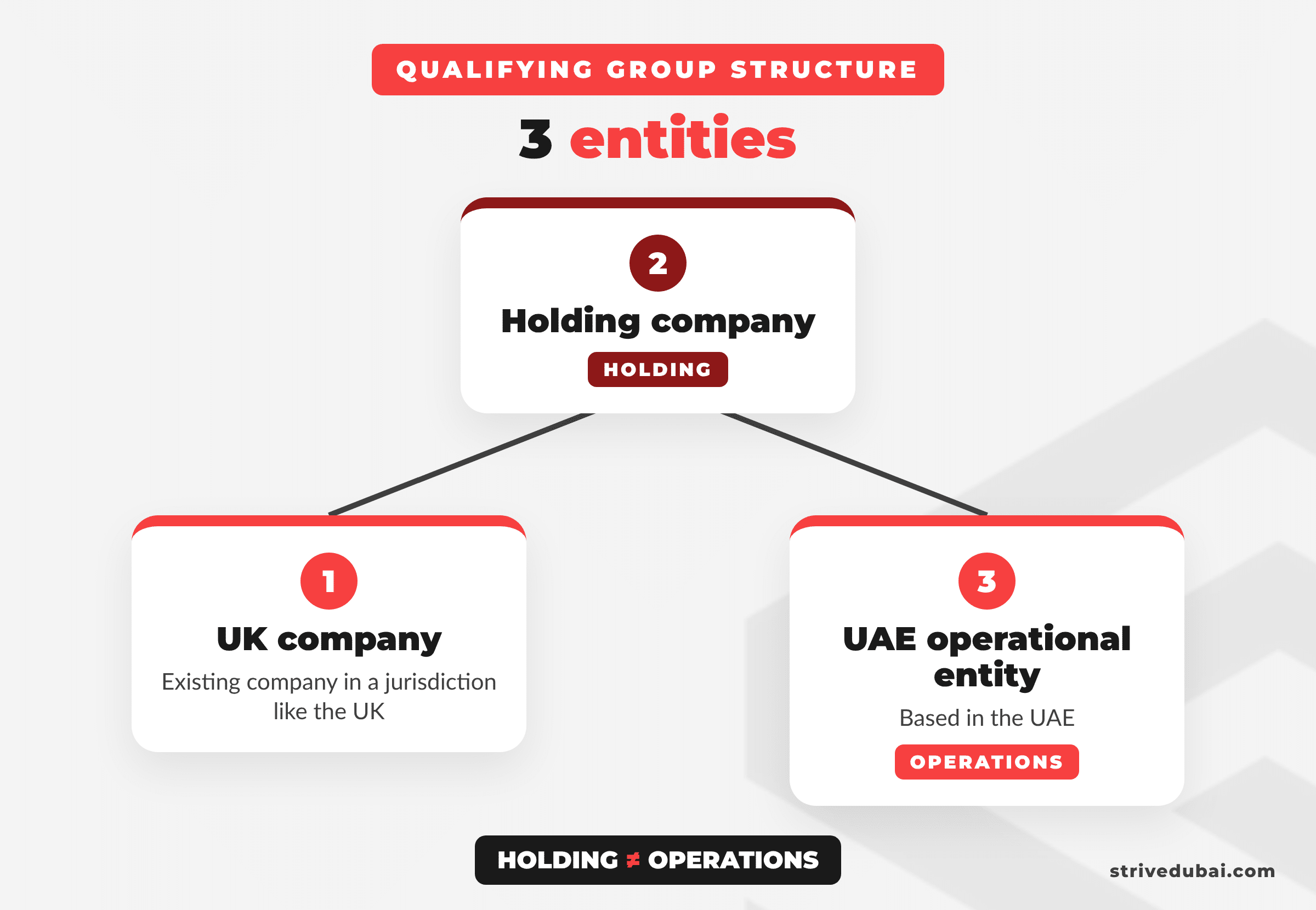
The right structure depends on the business. For many UK founders, one option Strive advises on is a qualifying group structure. At a basic level, it involves three entities:
- An existing company in a jurisdiction like the UK.
- A holding company.
- An operational entity based in the UAE.
The holding company and the operational company are kept separate. Many founders ask why the holding company can’t also be operational. The answer is that “operations and holding activities need to be separated” to satisfy HMRC and other tax authorities.
Done properly, this kind of structure can give founders more freedom to move money between the UK and the UAE without being excessively taxed back in the UK. Whether it suits you depends on your residency, your business and how it is run.
You also don’t need HMRC’s sign-off to set up this way. HMRC clearance is not a legal requirement for a group structure, as long as you follow the law. What matters is getting the structure right and running it properly.
Is your setup at risk? A 6-point check
Tick any that apply to you:
- You set it up for “0% tax” and no one asked about your UK situation.
- Your UK and UAE companies aren’t treated as separate entities.
- No one mentioned transfer pricing or arm’s length terms.
- You’re not sure how money should move between the UK and UAE.
- You don’t know how you’ll bring funds back to the UK.
- It was sold as a package, not a plan.
None ticked: you’re likely in good shape, though a periodic review is still wise. One or two: worth a review. Three or more: talk to an adviser before something hits the fan.
Get your setup checked
Not sure if your UAE setup is right? Book a free, no-obligation structure review with Strive’s UK–UAE team. We’ll review your UK and UAE structure, check how money moves between them, and talk you through your options.
Want the full conversation? Watch The 2026 UK–UAE Tax Playbook on YouTube.
This article is general information, not tax or legal advice. Every situation is different, so speak to a qualified adviser about your circumstances.